
Technical summary
This professional starter kit is specially designed for development on Atmel™ 8, 14, 20, 28 and 40-pin microcontrollers of the AVR™ family. With a very high build quality, the board (where every component is clearly identified) is supplied as standard with an ATMega32 microcontroller. Many example programs in "C", "Pascal" and "BASIC" will ensure you get started immediately.
Programming is done WITHOUT a BOOT Loader, which means you can place a blank Flash-technology AVR on the board and program it immediately!
The starter kit is supplied as standard with an ATMega32 microcontroller. Able to be clocked up to 16MHz, this microcontroller has 32KB of "Flash" program memory, 44 input/output ports (8 of which can be used as "analog/digital" conversion channels with a 10-bit resolution), 3 timers, various PWM signal management functions, a serial communication port, an SPI™ communication port...
More than 64 AVR microcontrollers supported
The "EasyAVR7" board can currently handle nearly 64 different AVRs (the list below shows only some of the supported AVRs - see the board's documentation for the complete list).
|
List of supported microcontrollers (AT90 family) |
|
| AT90PWM2 AT90PWM216 AT90PWM2B AT90PWM3 AT90PWM316 AT90PWM3B AT90S1200 AT90S2313 AT90S2323 AT90S2343 AT90S4433 AT90S8515 AT90S8535 |
|
List of supported microcontrollers (ATmega family) |
|
| ATmega1284 ATmega1284P ATmega16 ATmega161 ATmega162 ATmega163 ATmega164 ATmega164P ATmega164PA ATmega165 ATmega165P ATmega168 ATmega168P ATmega169 ATmega169P ATmega32 ATmega323 ATmega324 ATmega324P ATmega324PA ATmega328 ATmega328P ATmega32A ATmega48 ATmega48P ATmega48PA ATmega644 ATmega644P ATmega644PA ATmega8 ATmega8515 ATmega8535 ATmega88 ATmega88P ATmega88PA ATmega8A |
|
List of supported microcontrollers (ATtiny family) |
|
| ATtiny12 ATtiny13 ATtiny15 ATtiny2313 ATtiny24 ATtiny25 ATtiny26 ATtiny261 ATtiny4313 ATtiny44 ATtiny45 ATtiny461 ATtiny84 ATtiny85 ATtiny861 |
The bundled software suite
MikroProg Suite™
The "EasyAVR7" starter kit comes with a DVD containing the software for managing the board's USB programmer. This software (called MikroProg Suite™) offers many common functions: programming, reading, verification, blank check, protection, editing...

mikroelektronika compilers
The DVD also contains the demo versions of the BASIC (MikroBASIC PRO), "C" (MikroC PRO) and "PASCAL" (MikroPASCAL PRO) compilers for AVR microcontrollers. These demo versions (limited to 2 KB of code) let you experiment with most of the board's features. The full versions of the compilers can be purchased at the bottom of the page.
Many turnkey examples
The starter kit comes with many program examples written with the mikroelektronika compilers (some examples require optional expansion modules):
- Display on 7-segment LED digits in multiplexed mode
- Analog/digital conversion with display on LEDs
- Sending/receiving data over the RS232 port
- USB <> UART handling
- Displaying text on an LCD screen
- Driving the board's LEDs
- Displaying text and graphics on a graphic LCD screen
- LM35 sensor handling
- Sound generation
- EEPROM memory control
- Touch panel handling
- Etc, etc...

In addition to the basic examples supplied with the "EasyAVR7" starter kit, you have at your disposal a website dedicated to the mikroelektronika compilers, where you can download the source code of hundreds of applications. Updated regularly, this site is a mine of ideas and a valuable help for your developments. Click here to go to LIBSTOCK.
| Built-in USB programmer The "EasyAVR7" board includes a powerful USB-connected programmer that lets you download your programs (developed in assembler or with any AVR compiler) into the microcontroller you have inserted into one of the sockets. Programming is done without a bootloader, so you can place a "standard" AVR on the board and program it right away. |
 |
Debugging is possible using a JTAGICE programming probe (not included) via a connector provided for this purpose on the board.
The strong points of the "EasyAVR7" starter kit
 |
 |
 |
 |
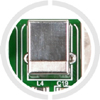
| Supplied with ATmega32 |
Dual regulation 3.3V and 5V |
USB connection for programmer |
RS232 port built-in |
 |
 |
 |
 |
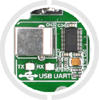
| Converter USB <> serial |
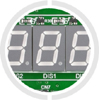
4 displays 7-segment LED |
Buzzer built-in |
Programmer built-in |
 |
 |
 |
 |
| LCD slot 2 x 16 optional |
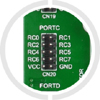
Ports brought out on male HE10 |
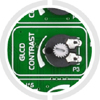
Contrast adjustment graphic display |
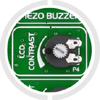
Contrast adjustment alphanumeric display |
 |
 |
 |
 |
| Touch panel controller |
LCD slot 128 x 64 optional |
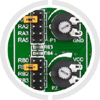
Potentiometer on ADC inputs |
24AA01 EEPROM built-in |
 |
 |
 |
 |
| Backlight control via PWM |
Ground lug brought out for measurements |
8 MHz crystal built-in |
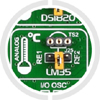
Slot for LM35 (optional) |
 |
 |
 |
 |
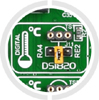
| Slot for DS1820 (optional) |
Connector for JTAG probe |
Socket (1) for ClickBoard module |
Socket (2) for ClickBoard module |
 |
 |
 |
 |
| Socket (3) for ClickBoard module |
36 LEDs built into the board |
Pull-up/pull-down (or none) selection |
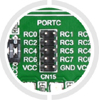
Ports brought out on male HE10 |
 |
 |
 |
|
| 36 built-in push buttons the board |
Ports brought out on pads |
Push button Reset on the board |
| Slots for "Click Board" modules The "EasyAVR7" board has 3 slots specially designed to take small expansion modules called "Click Board". These small optional modules will let you instantly add new capabilities and functions to your starter kit.Click here to see the list of "Click Board" modules |
 |
"EasyAVR7"... a scalable development tool!
 |
The "EasyAVR7" board has a multitude of male HE10 connectors giving access to the various input/output ports of the PIC microcontrollers.
These connectors also let you plug in other optional expansion modules able to add still more functions and capabilities to your starter kit: RS485 communication bus, wireless communication system, MP3 sound file playback, read/write capability on SD™ or CF™ memory cards, various sensors, display modules, analog/digital and digital/analog converters, etc, etc... |
Click here to see the list of expansion modules
The slots for Click™ Board modules as well as the HE10 male connectors will let you instantly add to your starter kit a GPS module, a GSM module, an IrDA communication module, a Bluetooth® module, a Wifi module, an Ethernet connection, a CAN communication bus, an RS485 port, an RS232 port, a fiber-optic data transmission system, a light sensor, a gyroscope, an accelerometer, an electronic compass, a temperature sensor, a capacitive sensor, a pressure sensor, an RTC clock, a microSD™ card storage system, a 4-20 mA converter, a "D/A" converter, an "A/D" converter, a digital potentiometer, a voice recognition module, a ".MP3" sound file playback module, relays, a joystick, a control module for a "DC" motor or for a stepper motor, an LED matrix, a video overlay system, an LED bargraph, etc...
Still more and more options!
We also offer as an option in the right-hand column a power supply, a DS18S20 temperature sensor, a 2 x16 character alphanumeric LCD display, a 128 x 64 pixel blue backlit graphic LCD display, a serial cable (if you want to use the board's RS-232 port), etc...
Very detailed documentation

With 36 pages entirely in color, the documentation of the "EasyAVR7" starter kit explains step by step (with the help of numerous illustrations and theoretical diagrams) how to configure the board for the AVR® you wish to use, how to use the programmer and the debugger as well as the various integrated or optional peripherals.

Contents supplied with the "EasyAVR7" starter kit
- 1 board (with an ATmega32) - without LCD display, touch panel, DS1820 sensor or serial cable
- 1 CD-ROM including the manual (in English) and the software suite
- 1 USB cable (for the integrated programmer)

